
'The pipeline of new industrial projects is the best I've seen in the last 10 years, and it looks solid enough to sustain for at least a few quarters,' points out Naushad Forbes, adding, 'It is only when we get back to the same labour force participation we saw before Covid that the economy will have truly recovered.'

'Unsurprisingly, Trump shared Modi's podcast with Fridman on his Truth account.' 'The intentions of Trump, a transactional president, are never easy to tell.' 'We will know in the next fortnight if and when he unfolds reciprocal tariffs on Indian goods, whether Modi's flattering words made any significant difference to Trump's compass,' notes Ambassador M K Bhadrakumar.

Consumer durables shrank year on year, which could suggest to observers that spending confidence is yet to return to the economy.

The Indian crew onboard a crippled container vessel that collided against a key bridge in Baltimore last week is healthy , according to a nonprofit organisation that has been in touch with the personnel.

'In the past six months, capital markets have seen a dip, and realty is struggling. The stock-market investor will be cautious of putting that investment in real estate when there may be a slowdown coming.'

'The finance minister has done as much as she can when you look into the fiscal constraints she had.'

India's fast-moving consumer goods (FMCG) sector grew 5.7 per cent by value and 4.1 per cent by volume in the July-September quarter driven by rural demand, consumer intelligence firm NielsenIQ said in its quarterly update on Thursday. Price-led growth stood at 1.5 per cent. According to NielsenIQ data, rural volume growth outpaced urban markets for the third straight quarter despite consumption softening in both regions.

Engineering and construction major Larsen & Toubro (L&T) reported a 25 per cent rise in net profit attributable to the owners of the company for the January-March quarter of 2024-25, owing to higher revenues and an exceptional gain. For the quarter under review, L&T posted a consolidated net profit of Rs 5,497.3 crore, while revenue rose 10.9 per cent year-on-year (Y-o-Y) to Rs 74,392.28 crore.

'Suddenly we had a new comprehension of affairs, which reminded that the luxury of politics floated atop a foundation by economics.' 'Along with this, finance ministers became crucial in molding the perception and reputation of Union Cabinets.' 'Governments couldn't afford a wrong person in that portfolio,' asserts Shyam G Menon.

So, while it is great that India's numbers look relatively good, don't raise a cheer just yet, points out T N Ninan.

Gold price outlook 2025: Gold prices that have climbed over 30 per cent so far in 2024 to Rs 7,300 per gram in the Indian markets (up 28 per cent in dollar terms till November-end), are set for their best calendar year performance in 10 years, suggests a recent report by World Gold Council (WGC). However, this stellar run, analysts believe, may not carry through till the end of 2025 in the backdrop of economic and geopolitical headwinds.

'Expect India to keep doing well irrespective of geopolitics.'

The brokerage said that the reform measures announced by the government will help growth only over the medium term and are not expected to have any benefit in the near-term.
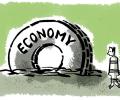
'Once the lockdown is lifted, we will see some pickup in demand.' 'And my sense is that it will be a long walk this time given that we have lost three months of economic activity.'

The Indian economy's election-year syndrome cannot be ignored, says A K Bhattacharya.

India's e-commerce market alone is projected to reach $200 billion by 2026, making it a prime industry for ambitious entrepreneurs, explains rediffGURU Harsh Bharwani.

Exporters on Thursday sought a fund of Rs 750 crore for three years to tap USD 25 billion export potential in the US, aiming to seize potential opportunities that may arise as the US President-elect, Donald Trump, has threatened to impose high tariffs on Chinese goods. In its pre-Budget meeting with the finance ministry, Federation of Indian Export Organisations (FIEO) President Ashwani Kumar has also demanded extension of the five per cent Interest Equalisation Scheme (IES).

The director of the Indian Institute of Technology (IIT) Madras, V Kamakoti, has sparked controversy after making a remark about the "medicinal value" of cow urine, or "gomutra." Kamakoti, while speaking at an event celebrating Maatu Pongal (a festival dedicated to cows and bulls), cited an anecdote about a sanyasi who was cured of a fever by consuming gomutra. He also claimed that gomutra has "anti-bacterial, anti-fungal, and digestive properties." The remark has been widely condemned by rationalist organizations, political leaders, and medical professionals who have criticized Kamakoti's statements as "pseudoscience" and "regressive." The controversy highlights the ongoing debate in India around traditional beliefs and scientific evidence.

NITI Aayog has not said what the reasons were for having achieved or not having achieved what was sought to be achieved, or what lessons can be learned for the future, points out Aakar Patel.

Have the markets already played out their dynamics before the economy has even properly taken off? Are we now destined for a period of mediocre returns despite a strong economy? asks Akash Prakash.

India's services PMI recovered from its ten-month low in September to reach 58.5 in October supported by strong expansions in output and new business, which in turn boosted job creation, a monthly survey said on Wednesday. The seasonally adjusted HSBC India Services Business Activity Index increased from 57.7 in September to 58.5 in October, as robust sales pipelines and strong demand conditions supported the upturn in business activity. In the Purchasing Managers' Index (PMI) parlance, a print above 50 means expansion, while a score below 50 denotes contraction.

Market reaction to the Union Budget was overall neutral. The income tax "gift" wasn't enough to move the needle. There was some apparent rationalisation of Customs duty structure as well as cuts on import duties of some key components for the telecom and IT industry and duty cuts on vehicle imports. Other proposals related to development of agriculture and rural economy and renewables seem to be generally positive.

'Inflation is not good for industry. Nor for the economy as a whole.'

'The shifts in US involvement in global conflicts and geopolitical alliances could introduce uncertainties.'

'Reduce your equity allocation, put that allocation into gold and fixed income.'

After a brutal selloff since October, foreign portfolio investor (FPI) flows for the year-to-date (YTD) in 2024 have turned negative. In early September, YTD FPI investments peaked at a record Rs 22,000 crore ($2.6 billion). This wave of selling has also pulled down benchmark indices, with the Nifty's YTD returns declining to 11 per cent from their high of 21 per cent in September.

India's manufacturing sector growth recovered from September's eight-month low to 57.5 in October fuelled by faster increases in total new orders and international sales, a monthly survey said on Monday. The seasonally adjusted HSBC India Manufacturing Purchasing Managers' Index (PMI) rose from September's eight-month low of 56.5 to 57.5 in October, indicating a substantial and accelerated improvement in operating conditions.

Excess earnings of unlisted companies over and above their interest costs are at a record level. The interest-coverage ratio of 2.94 is the highest going back to 1990-91, according to numbers from the Centre for Monitoring Indian Economy (CMIE). The ratio measures earnings relative to every rupee to be paid as interest on outstanding debt.

Fintech major PhonePe on Wednesday announced the launch of its homegrown Indus Appstore specifically for the Indian market, in a bid to compete with global incumbents like Google Play Store and Apple's App Store. The Indus Appstore is PhonePe's attempt at creating a more competitive and localised mobile app store economy for India, which is already the world's largest market for mobile apps.

The Indian economy continues to sustain the momentum achieved in the first half of 2023-24 and expectations of a fresh round of capex by the corporate sector is likely to fuel the next leg of growth, the Reserve Bank Bulletin said on Tuesday. "The likelihood of the global economy exhibiting stronger than expected growth in 2024 has brightened in recent months, with risks broadly balanced," said an article on 'State of the Economy' published in the bulletin.

After navigating the turbulent pandemic waves, the recovering Indian economy is now sailing through unchartered waters of rising coronavirus cases, spiralling commodity prices and spiking inflation though the lighthouse of sustainable growth remains visible. As 2022 begins, a raft of developments, ranging from Budgetary announcements to continuation of stimulus measures to monetary policy, will set the tone for the domestic economy, which is projected to grow more than 9 per cent in the current fiscal ending March 2022. The country's continuing massive vaccination drive and 'precaution' doses starting for select categories of people this month will provide a firewall against any steep spike in coronavirus cases amid the emergence of the Omicron variant.

A day after lambasting e-commerce players for predatory pricing, Union Commerce Minister Piyush Goyal on Thursday said he is not against online platforms but India wants such entities to be "fair and honest" in their conduct. Speaking with reporters in the financial capital, the outspoken Union minister said the rule of the law should be followed in letter and spirit, and made it clear that consumer preferences should not be influenced by algorithms.

The recent stimulus measures announced by China have seen most analysts sit up and take notice.

'It is far too early to celebrate the numbers.' 'They are still fairly weak compared to the pre-pandemic level.'

Both new and completed project values as of December 2024 remain below pre-pandemic levels seen in 2019.

'If it doesn't, it will continue with measures to infuse liquidity, signalling a new cycle,' predicts Tamal Bandyopadhyay.

Automobile, apparel and electronics are among sectors that see a sales boost during the festival season, a time when investors expect gains in related stocks. This year could be different: Analysts have factored in all positives and do not expect such stocks to deliver lucrative returns. "Indian households spend across sectors like automobiles, consumer durables, and consumer staples during the festival season.

Following the lacklustre growth numbers in the second quarter (Q2FY25), economists believe the upcoming Union Budget for 2025-26 should focus on reforms that will stimulate consumption, manufacturing and spur employment. India's growth unexpectedly slowed to 5.4 per cent in the second quarter, due to low capital formation, weak consumption, besides adverse weather impact.

If as critics point out, the environmental impact assessment study was commissioned only after the auction process got underway with not all the stakeholders getting to know of it, then the government has already compromised the trust it could have enjoyed with Kerala's public including its coastal communities, points out Shyam G Menon.

Food delivery app Swiggy on Wednesday launched a Rs 11,330-crore initial share sale, asking investors to take a pie of Indian middle class' rising propensity of online ordering. The company, which is present in over 650 cities and towns of the country, is launching the initial public offering (IPO) amid heightened concerns on urban demand slump, and the management stressed that it is unaffected by the broader trends in the economy. "We are also reading about it, but we are not seeing that yet in the business... So far, we have not seen the impact of demand on our business," its chief financial officer Rahul Bothra said.
